

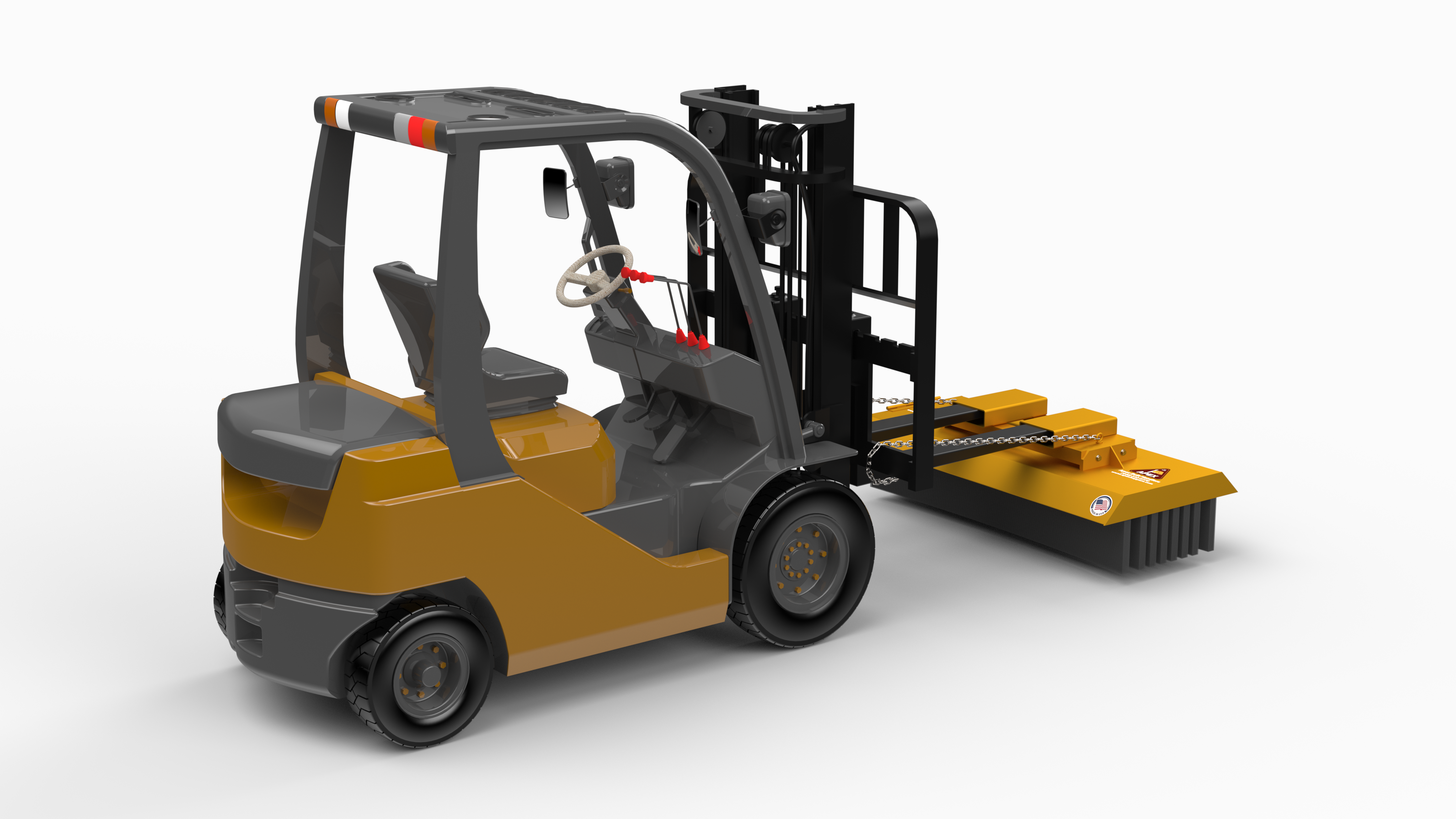
Forklift Sweeper Attachment Costs: What a Fork-Mounted Broom Really Saves
Every warehouse, yard and plant floor fights the same daily battle: dust, gravel, scrap and spilled material that slow operations down and create safety hazards. Most facilities handle it with a cleaning crew, a dedicated sweeper machine, or a few people pulled off their regular work with hand brooms. If you’re looking at a forklift sweeper attachment instead, the question is simple: what does it actually save, and which kind do you need? This guide walks through the labor math and explains when a fork-mounted push broom does the job without the cost of a powered sweeper.
The Hidden Cost of Manual Industrial Cleaning
Manual sweeping rarely shows up as its own line item, which is exactly why it’s easy to underestimate. It’s buried in overtime, in temp labor invoices, and in the hours an operator or warehouse associate spends pushing a broom instead of moving product.
Labor you’re already paying for
Sweeping a large floor or yard by hand takes hours every week, and those hours come out of someone’s regular job. Over a year, at a fully loaded labor rate, manual cleaning can add up to the cost of a part-time position you never officially created.
Downtime and safety risk add up
Debris left between cleanings contributes to slip hazards, damaged tires on material handling equipment, and contamination in production areas. Those costs never appear on a cleaning invoice, but they hit the bottom line just the same.
Two Kinds of Forklift Sweeper Attachments
“Forklift sweeper attachment” covers two different tools, and the difference decides both the price and the upkeep.
- Powered (rotary) sweeper attachments spin a brush with a hydraulic or electric drive. They need auxiliary hydraulics or power on the truck, and they bring motors, hoses and brushes to maintain.
- Forklift push brooms have no moving parts. The broom rides on the forks and the forklift does the pushing, so there’s nothing to hook up and very little to service.
We cover the full comparison in our guide to forklift broom attachments. For most routine warehouse, yard and jobsite cleanup, the push broom is the one that pays back fastest, and it’s the one we build.
What a Forklift Push Broom Replaces
Our forklift push broom slides onto the fork pockets of equipment your team already runs. That replaces three separate costs with one attachment.
Instead of a cleaning crew
Outside crews bill by the hour or by contract and have to be scheduled around your production. An operator who’s already on the floor can sweep an aisle, a dock or a yard between other tasks, with a 60-inch sweeping path on every pass.
Instead of a standalone sweeper machine
A ride-on sweeper is a capital purchase with its own engine, maintenance, storage and training. A push broom uses the forklifts you’ve already paid for: there’s no extra vehicle to buy, fuel, insure or find space for.
Instead of a powered sweeper attachment
A rotary attachment needs auxiliary hydraulics or electrical power on the truck. If your forklifts don’t have them, that’s an added cost before you sweep anything. A push broom needs neither, and it produces less dust than a rotary brush.
Run the Labor Math for Your Facility
Every facility is different, so here’s a simple way to estimate the savings with your own numbers:
- Current hours: how many hours a week go to sweeping by hand or to an outside crew?
- Labor rate: what does an hour cost, fully loaded (wages, taxes, benefits)?
- Hours with a broom: how long would the same areas take with a forklift and a 60-inch broom, folded into existing routes?
- Annual savings: (current hours − hours with a broom) × labor rate × 52.
For example, if a facility spends 10 hours a week sweeping at $20 an hour and a forklift broom brings that down to 3 hours, the savings would be 7 × $20 × 52 = $7,280 a year. Those inputs are only an illustration: plug in your own hours and rate, then compare the result with the price of the attachment.
Use Cases: Warehouses, Yards and Manufacturing Floors
Warehouses and distribution centers
Dust, packaging debris and pallet fragments build up fast in high-traffic aisles. A broom on the forks lets operators clear them between put-away runs without a separate cleaning pass.
Outdoor yards and lots
Gravel, dirt and loose scrap wear down tires and leave uneven surfaces. A push broom handles concrete, asphalt and gravel, and it clears snow and leaves in the off-season too.
Manufacturing floors and job sites
Scrap and production residue need to be cleared regularly to protect equipment and keep walkways safe. Once the material is pushed into a pile, a forklift scoop bucket or a self-dumping hopper picks it up and carries it off with the same truck.

Choosing the Right Apex Push Broom
All three Apex models share a heavy-duty steel frame, a 60-inch sweeping width and the same fork-pocket mounting. They also fit skid steers, loaders and similar equipment, and custom mounting is available. The difference is bristle density:
| Model | Bristle rows | Weight | Best for |
|---|---|---|---|
| PB/400 | 4 | 227 lbs | Everyday floor and yard cleaning, lighter debris |
| PB/600 | 6 | 250 lbs | General-purpose sweeping, mixed debris |
| PB/800 | 8 | 280 lbs | Denser contact for heavier debris |
A few details keep the cost of ownership low:
- No auxiliary hydraulics or electrical power, so it works with any forklift’s standard forks
- Tool-free, five-minute bristle change, so the attachment stays in service instead of being replaced
- First and last bristle rows curved inward, to keep swept material from escaping over the edges
- Built in-house in Cleveland, Ohio, at the same site where Apex Welding and Fabrication has been fabricating steel since 1946
Checklist Before You Buy
- Estimate the hours a week you spend today on manual sweeping or outside crews
- List the areas you’ll cover: indoor aisles, docks, outdoor yards
- Check what you’re sweeping: fine dust, gravel, scrap, snow
- Check whether your trucks have auxiliary hydraulics, if you’re considering a powered sweeper
- Compare the one-time cost of the attachment with a year of labor or contractor invoices
If a fork-mounted broom fits your operation, browse the forklift push broom models or request a quote and tell us what you sweep and what you’ll mount it on. We’ll help you pick the right bristle configuration.
Frequently Asked Questions
Is a forklift push broom the same as a forklift sweeper?
Not quite. A powered sweeper attachment spins a brush with hydraulic or electric drive. A push broom has no moving parts and needs no auxiliary power: the forklift pushes it.
What sizes do Apex forklift push brooms come in?
Three bristle-row configurations: the 4-row PB/400 at 227 lbs, the 6-row PB/600 at 250 lbs and the 8-row PB/800 at 280 lbs, all with a 60-inch sweeping width.
How do you attach a broom to a forklift?
Slide the broom onto the forks through its built-in fork pockets, center it, and secure it with the safety pin or locking mechanism before sweeping.